
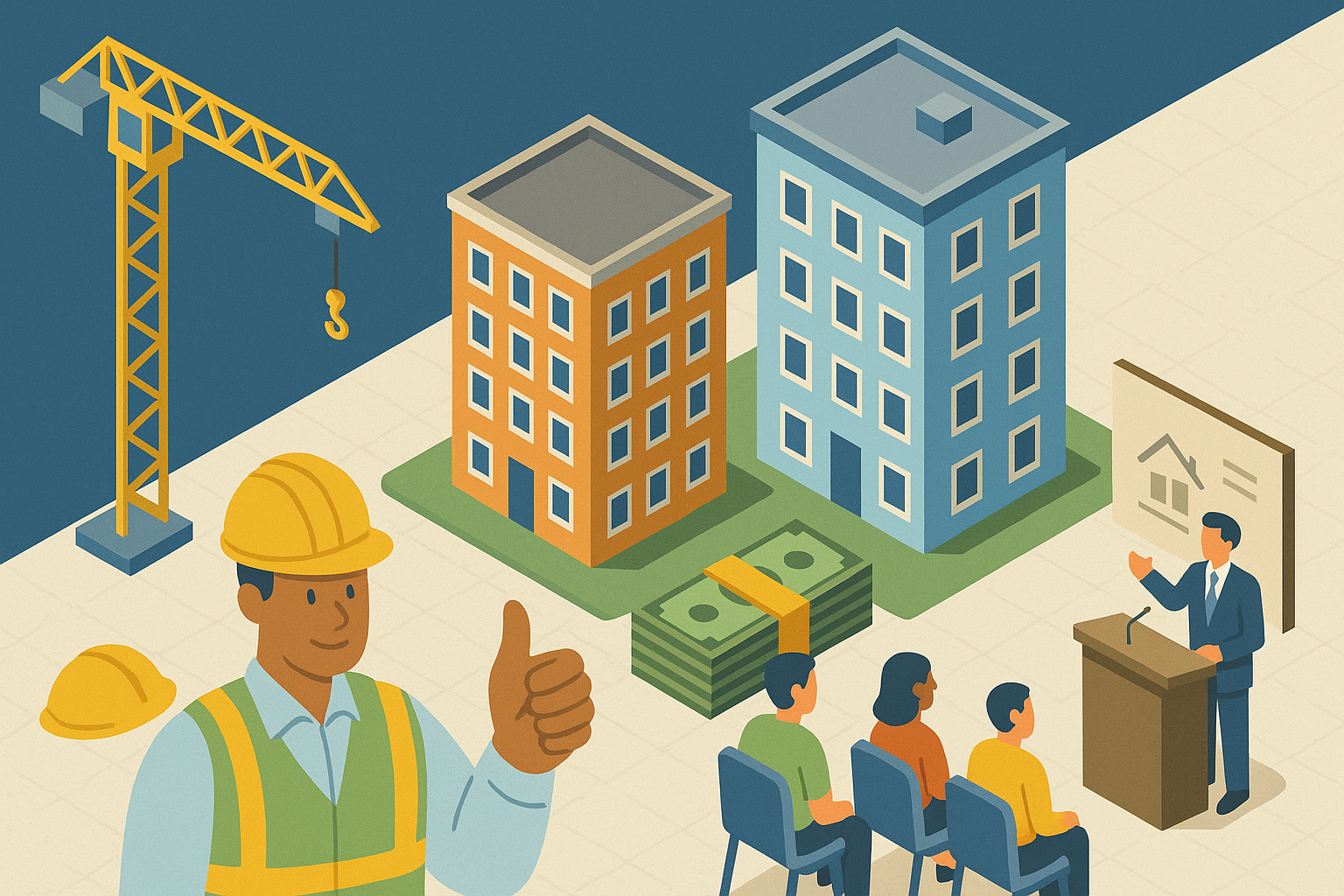
AKA: The Nextdoor Commenter’s Guide to the Reality of Development
Why You’re Reading This
You’ve seen it before. Someone posts on Nextdoor about a proposed apartment building, and the comments explode: “They’re ruining our neighborhood!” “It’ll be luxury housing we can’t afford!” “It’ll bring crime!” “Developers are greedy!”
There’s passion in these discussions, but there’s also a lot of misinformation. This isn’t here to convince you to love every development, but to explain what actually happens when someone builds multifamily housing, especially the parts you don’t see.
If we’re going to have real conversations about housing, we should at least argue over the truth.
The Reality: Building Housing Is Expensive and Risky
Let’s follow a typical project: a 300-unit apartment community with a total cost of around $100 million. What you don’t see is how much money gets spent—and potentially lost—before ground is even broken.
The Million-Dollar Gamble Before Breaking Ground
Contrary to popular belief, developers rarely buy land outright at the start. Instead, they sign contracts giving them months, a year, or longer to research whether the project makes sense. During this period, they might spend:
- Hundreds of thousands in legal fees for contracts, entity formation, and title work
- Hundreds of thousands in architectural and engineering fees for site plans, design documents, traffic studies, environmental assessments, and stormwater management
- Tens to hundreds of thousands in deposits for appraisers, surveyors, and other third-party consultants
- Tens of thousands in city fees just to submit applications
All before they even own the land. If the project gets denied or the economics fall apart? All of that upfront investment—often over $1 million—is lost.
The Bureaucratic Marathon
Most land doesn’t automatically allow apartments. Developers often need zoning changes or special permits, which means:
- Neighborhood meetings and public hearings
- Traffic studies, tree studies, stormwater plans
- Months or years of waiting and revising plans
- Every design change adds time and cost
The public input matters, but cities have to follow their own legal processes. And every delay increases risk.
Traffic Studies and Infrastructure Improvements
One of the most expensive requirements is the traffic impact study. These aren’t just paperwork exercises—they’re detailed analyses by professional engineers who count cars, model traffic patterns, and predict impacts.
When these studies show that a development will affect traffic flow, developers are often required to pay for off-site improvements like:
- New traffic signals at nearby intersections
- Additional turn lanes
- Roadway widening
- Pedestrian crossings and sidewalk connections
These improvements can cost hundreds of thousands or even millions of dollars, and they often benefit the entire community—not just the new development. The irony? Many of these improvements address traffic problems that already existed but were never funded until a new development came along to pay for them.
The House of Cards Called Financing
Developers don’t usually bankroll projects themselves. They bring in investors and banks who expect returns and get nervous if projects take too long or costs spiral. This financial structure—called the “capital stack”—can collapse if one piece fails, like if construction costs jump 10% or interest rates rise.
When you hear “they’re rushing to build,” understand: they’re racing against a financial clock that could kill the entire project.
Busting the Most Common Myths
“They’re Just Building Luxury for the Rich”
New buildings cost a lot to construct. Between land prices, labor, materials, design costs and permitting fees, it’s nearly impossible to make new apartments cheap initially. “Luxury” often just means “has a dishwasher and decent lighting.”
Here’s the key: housing “filters” over time. Today’s new units become tomorrow’s more affordable options. If we stop building today, we cut off tomorrow’s supply of naturally affordable housing.
“It’s Too Expensive AND It Will Bring Crime”
This contradiction appears in every public hearing. New apartment communities require background checks, income verification, and credit screenings. These are some of the most tightly managed properties in a city, with controlled access systems that are getting more sophisticated by the day.
Crime isn’t caused by renters or affordability—it’s tied to disinvestment, poor management, and lack of opportunity. None of which describe a brand-new, well-leased property. While statistically
“They Should Have Known the Land Wasn’t Zoned for Apartments”
This one comes up constantly: “Why didn’t they just buy land that was already zoned correctly?”
Here’s the reality: most cities have very little land zoned for multifamily housing. Developers often have to request zoning changes because that’s the only way to create more housing. The alternative—only building on pre-zoned land—would mean almost no new apartments ever get built.
Remember, developers don’t buy the land first and then hope for rezoning. They sign contracts that let them spend months or years getting approvals before they close on the purchase. If the zoning request fails, they walk away and lose their upfront investment, but they don’t get stuck owning land they can’t use.
“Our Schools Are Already Overcrowded”
This sounds logical, but the math doesn’t work the way most people think. Urban apartment developments typically generate far fewer students than suburban single-family neighborhoods.
Why? Apartments attract young professionals, empty nesters, and smaller households. A 300-unit apartment building might generate 30-50 students across all grade levels, while 300 single-family homes could generate 200+ students. Plus, apartments contribute more in property taxes per student than single-family homes because they’re higher density.
Many school districts actually prefer well-designed multifamily development because it provides more tax revenue per student served.
“They’re Destroying Our Neighborhood Character”
It’s fair to care about aesthetics. But consider: density done right means more foot traffic for local businesses, more vibrant streets, and more options for aging parents, adult kids, or teachers to live nearby.
Design can be improved. But stopping growth entirely guarantees sprawl, higher costs, and longer commutes for everyone.
“They’re Making a Fortune”
Sometimes, yes. But often, no. Most developers don’t break even unless the project finishes on time, leases up quickly, and avoids major surprises.
If interest rates spike, materials get delayed, or the market slows down, developers can lose millions. Unlike homeowners with 30-year mortgages, they borrow money on strict short-term timelines with lots of strings attached.
Why We Actually Need More Housing
Rising home prices and rents affect everyone—your kids, your friends, your aging parents, and your local school staff. If your community is desirable, people will want to live there. If there isn’t enough housing, prices go up.
More housing doesn’t mean chaos. It means options. And if we want to preserve what makes our neighborhoods great, we need to make room for the next generation, too.
How to Support Better Development
Instead of just opposing projects, here’s how to make a real difference:
- Show up to public meetings with constructive ideas, not just opposition
- Ask questions about design, walkability, and traffic—but keep an open mind
- Push for quality standards rather than arbitrary bans
- Support diverse housing types, from duplexes to apartments to ADUs
- Vote for city leaders who understand housing policy
A Note to Developers: Earn the Trust You Want
If you’re a developer, community resistance might feel frustrating—but it’s often rooted in uncertainty and fear. Don’t underestimate the value of transparency and good communication.
Here’s how to build credibility:
- Engage early and often. Don’t wait until the public hearing
- Be clear, not slick. Skip buzzwords and explain in plain language
- Show visuals. Renderings help translate abstract plans into something tangible
- Explain the why. You’re immersed in zoning codes and pro formas, but the public isn’t. Walk them through your thinking: why you chose this site, why you designed it this way, why the community needs it.
- Understand the where. Know your market deeper than spreadsheets can show. Discover what residents cherish about their neighborhood and demonstrate how your project will strengthen those qualities.
- Acknowledge concerns. Even if you can’t solve every issue, recognizing them matters
- Be visible. It’s hard to vilify someone who shows up in good faith
Development isn’t just about buildings—it’s about relationships. Earn the community’s trust before you ask for their support.
The Bottom Line
- Developers don’t get rich quick—it’s high risk, high stress, and capital intensive
- Apartments aren’t crime factories—they’re homes
- Housing that seems expensive today becomes tomorrow’s affordable housing
- We need more homes, not fewer, if we want our communities to thrive
- Thoughtful growth beats reactive opposition every time
Let’s stop shouting past each other and start solving real problems. One honest conversation at a time.
If you’re working on a multifamily development in the Carolinas and want support navigating community engagement, entitlement risk, or market analysis, reach out to Scholhamer Research & Advisory. We help development teams earn trust and move forward with confidence.